

Flexibility training is a structured practice of stretching and mobility exercises designed to increase the range of motion around a joint or group of joints. It reduces stiffness, supports better movement quality, and lowers injury risk when combined with strength work. The right approach depends on your goals, age, and activity level — details covered throughout this guide.
Most people only think about flexibility training when something already hurts — a tight lower back after sitting all day, hamstrings that refuse to loosen up before a run, or shoulders that ache from hours at a keyboard. By then, mobility has usually been declining quietly for years. Research published by the National Institute on Aging points out that flexibility, alongside strength, balance, and endurance, is one of the four pillars of physical fitness — yet it’s the one most consistently neglected in everyday exercise routines.
This guide breaks down what actually works, based on physiology, not gym folklore. It covers the different types of flexibility training, how to build a routine that fits your schedule, what to do if you’re an athlete, a desk worker, or over 60, and which common habits are quietly working against you. The goal is a resource complete enough that you won’t need to search elsewhere to build a solid, safe flexibility practice.
What Is Flexibility Training and Why It Matters
Flexibility refers to the ability of a joint or series of joints to move through an unrestricted, pain-free range of motion. Flexibility training is the deliberate practice of exercises — stretches, mobility drills, controlled movements — that maintain or improve that range over time.
It’s easy to confuse flexibility with mobility, and the distinction matters. Flexibility is passive: how far a muscle can lengthen when an external force (gravity, a strap, another person) moves the joint. Mobility is active: how far you can move a joint under your own muscular control. A gymnast doing the splits demonstrates flexibility; a person squatting deep with control while keeping their heels down demonstrates mobility. Good flexibility training programs address both.
Why does this matter beyond touching your toes? Tight muscles pull joints out of their optimal alignment, which changes how force travels through the body during daily movement and exercise. The American College of Sports Medicine includes flexibility work in its general fitness recommendations precisely because restricted range of motion is linked to compensatory movement patterns — the kind that eventually show up as knee pain from tight hips, or lower back strain from stiff hamstrings.
In practice, people who neglect flexibility training for years often don’t notice the decline until a specific task becomes difficult: reaching a top shelf, getting up from the floor without using their hands, or rotating to check a blind spot while driving. These aren’t dramatic injuries — they’re the slow erosion of functional range that flexibility training is specifically designed to prevent.
Read also: “Portion Control Guide: Eat Smart, Feel Great“
The Science Behind Flexibility: How Your Body Adapts
Muscles and connective tissue (tendons, fascia) adapt to the ranges of motion they’re regularly exposed to. This is a use-it-or-lose-it system. When a joint isn’t taken through its full range consistently, the surrounding tissue gradually shortens and stiffens — not because the fibers physically shrink in a permanent sense, but because neural and mechanical adaptations reduce the tissue’s tolerance for stretch.
A stretch reflex is your nervous system’s built-in resistance to sudden lengthening. When a muscle is stretched too quickly, sensory receptors called muscle spindles trigger a protective contraction to prevent tearing. This is exactly why ballistic bouncing stretches carry more injury risk than slow, controlled ones — the nervous system interprets rapid stretch as a threat and fights back.
Two mechanisms explain most flexibility gains from consistent training. The first is neurological: repeated stretching reduces the sensitivity of the stretch reflex over a period of weeks, allowing the muscle to tolerate a greater range before the protective contraction kicks in. The second is mechanical: connective tissue undergoes gradual remodeling with sustained, repeated loading, becoming more extensible over months of consistent practice.
A widely cited review in the Journal of Strength and Conditioning Research, discussed by Harvard Health Publishing, found that stretching sessions performed at least 2-3 times per week for 4 weeks produced measurable improvements in range of motion, while gains plateaued without continued practice — flexibility, unlike some strength adaptations, decays relatively quickly once training stops.
This has a practical implication that’s often overlooked: flexibility training is not a one-time fix. A single deep stretching session before a race won’t undo years of sedentary sitting, and stopping a stretching routine for a few months will likely reverse most of the range-of-motion gains made.
Types of Flexibility Training
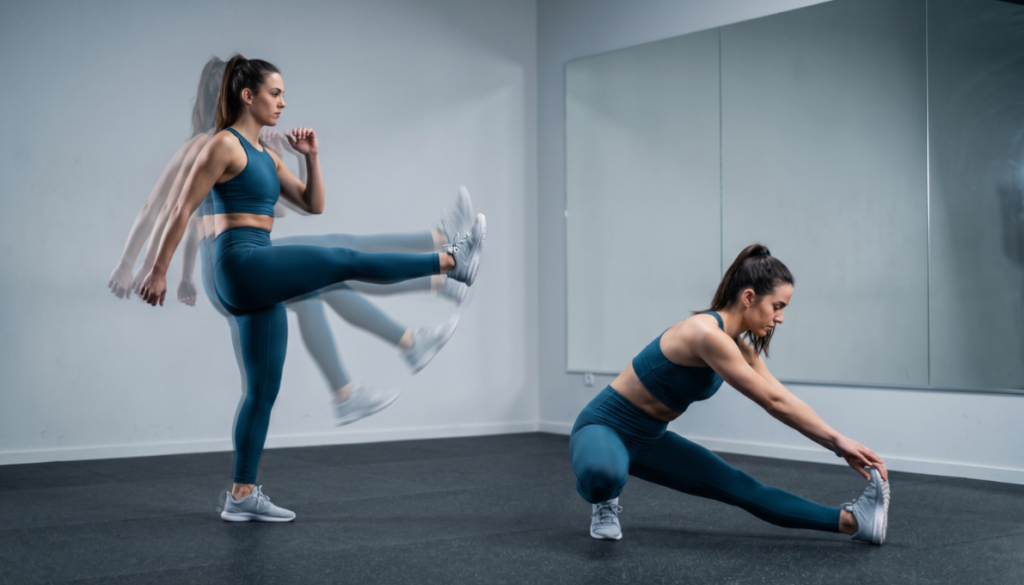
Not all stretching is the same, and using the wrong type at the wrong time is one of the most common mistakes people make. Four main categories cover almost everything used in modern flexibility training.
Static stretching involves holding a muscle in a lengthened position without movement, typically for 15-60 seconds. It’s the type most people picture — reaching for your toes and holding. It’s most effective after exercise, when muscles are warm, and is generally not recommended immediately before explosive activity, since some research suggests it can temporarily reduce power output.
Dynamic stretching uses controlled, active movements through a joint’s range of motion — leg swings, arm circles, walking lunges with a twist. It raises tissue temperature and primes the nervous system for activity, which is why it’s the standard warm-up choice before sports or strength training.
PNF stretching (proprioceptive neuromuscular facilitation) combines passive stretching with isometric contraction, usually performed with a partner or resistance band. The muscle is stretched, then contracted against resistance for several seconds, then stretched further into the new range. It tends to produce faster range-of-motion gains than static stretching alone but requires more technical guidance to perform safely.
Ballistic stretching uses bouncing or momentum to push a muscle past its normal range. It’s largely fallen out of favor in general fitness because it triggers the protective stretch reflex described earlier, increasing strain risk — though it still has a narrow, supervised application in some elite sports training.
| Type | Best Used | Typical Duration | Risk Level |
|---|---|---|---|
| Static | After exercise, cool-down | 15-60 sec per hold | Low |
| Dynamic | Before exercise, warm-up | 30-60 sec per movement | Low |
| PNF | Dedicated flexibility sessions | 6-15 sec contract, 20-30 sec stretch | Moderate (needs guidance) |
| Ballistic | Sport-specific, advanced athletes | Brief, repeated bounces | Higher |
Flexibility training is not one single technique but a family of methods, each suited to a different moment in a workout. Dynamic stretching belongs before activity, static and PNF work best afterward or in dedicated sessions, and ballistic stretching is a specialized tool rather than a default choice.

How to Build a Flexibility Training Routine
A flexibility training routine doesn’t need to be complicated to be effective. Consistency matters more than duration, and a well-structured 15-minute session performed several times a week tends to outperform a sporadic 45-minute stretch done once a month.
- Warm up first. Spend 3-5 minutes on light cardio or dynamic movement before stretching. Stretching cold tissue increases strain risk and reduces the effectiveness of the stretch itself.
- Target the major muscle groups. Prioritize hip flexors, hamstrings, calves, chest, and shoulders — the areas most affected by prolonged sitting and repetitive movement patterns.
- Hold static stretches for 20-30 seconds. Shorter holds have limited effect on range of motion; much longer holds add time without proportional benefit for most people.
- Breathe through the stretch. Holding the breath tightens the nervous system’s guard response; slow, steady breathing helps the muscle relax into the new range.
- Repeat 2-4 times per muscle group. A single hold produces some benefit, but repeated sets tend to deepen the range achieved within a session.
- Train at least 3-4 times per week. This matches the frequency associated with measurable range-of-motion improvements in most clinical research on flexibility training.
- Progress gradually. Small increases in range over weeks are sustainable; forcing a deep stretch before the tissue is ready is one of the most common causes of strain.
Quick tip: If a stretch causes sharp or shooting pain, stop immediately. A mild pulling sensation is normal; pain is a signal that the tissue is being pushed past a safe limit.
Flexibility Training for Different Goals
A flexibility training program should be adapted to the person, not applied as a one-size-fits-all template. What benefits a competitive gymnast can be excessive or even counterproductive for someone managing joint pain, and what helps a sedentary office worker may be insufficient for an athlete preparing for competition.
Athletes and Active Individuals
For people training for sport, flexibility work usually needs to be sport-specific. A swimmer benefits from shoulder and thoracic spine mobility; a sprinter needs hip flexor and hamstring range that supports stride length without sacrificing power. Dynamic stretching before training and PNF or static work afterward tends to be the standard combination recommended in sports performance settings, according to guidance summarized by the American College of Sports Medicine.
Desk Workers and Sedentary Lifestyles
Hours of sitting shorten hip flexors and weaken the muscles that support upright posture, creating a specific pattern of tightness that differs from an athlete’s needs. Short, frequent mobility breaks — even 5 minutes every hour — tend to be more effective for this group than a single long session at the end of the day, since the goal is interrupting sustained static posture rather than simply increasing maximum range.
Older Adults
Flexibility naturally declines with age due to reduced collagen elasticity and joint fluid changes, but this decline is significantly slower in people who maintain regular movement. Gentle, consistent flexibility training supports independence in daily tasks like bending, reaching, and balance-related movements — a priority area highlighted by the National Institute on Aging in its recommendations for healthy aging. For this group, slower progression and more supervision are generally advisable, particularly for anyone with existing joint conditions.
Read also: “Strength Training Benefits: 12 Science-Backed Reasons“
Common Mistakes and Myths in Flexibility Training
Static stretching before intense exercise reduces injury risk. This is one of the most persistent myths in fitness. Current evidence more consistently supports dynamic stretching as the warm-up choice, with static stretching reserved for after activity, since holding long static stretches on cold muscle can temporarily reduce force output in the stretched muscle group.
A second common error is treating flexibility training as an occasional add-on rather than a consistent habit. Because range-of-motion gains fade without continued practice, sporadic effort produces limited long-term benefit — a pattern confirmed in the flexibility research summarized by Harvard Health Publishing.
A third mistake, often seen in people pushing for fast results, is forcing a stretch to the point of pain in hopes of speeding up progress. This tends to backfire: pain triggers the protective stretch reflex described earlier, which tightens the muscle rather than lengthening it, and repeated overstretching increases the risk of tissue strain.
Finally, many people focus exclusively on hamstrings and calves while ignoring hip rotators, thoracic spine mobility, and shoulder range — areas that are just as commonly restricted and often more directly linked to functional movement quality in daily life.
Tools and Equipment That Support Flexibility Training
Equipment isn’t required for effective flexibility training, but certain tools make specific stretches more accessible or more comfortable. Foam rollers support self-myofascial release, which some people use before stretching to reduce muscle tension. Resistance bands and stretching straps help achieve positions that would otherwise require a partner, particularly useful for hamstring and shoulder stretches. Yoga blocks provide support for people who don’t yet have the range to comfortably reach the floor in certain positions, allowing proper form without forcing an unsafe range.
None of these tools replace consistent practice — they simply make specific movements more accessible, especially for beginners or people returning to flexibility training after a long break.
Flexibility training is a practical, evidence-supported way to maintain range of motion, reduce stiffness, and support better movement quality throughout life. The type of stretching that works best depends on timing — dynamic before activity, static or PNF afterward — and the routine itself should be adapted to individual goals, whether that’s sport performance, desk-job recovery, or healthy aging. Consistency matters more than intensity: a modest routine performed several times a week will outperform occasional long sessions. Building flexibility training into a regular schedule, even briefly, tends to pay off in ways that become most obvious the day it’s missing.
Important Disclaimer
The information in this article is for educational and informational purposes only and does not replace the evaluation or guidance of a qualified health professional. Consult a doctor or physical therapist before starting a new exercise or flexibility program, especially if you have an existing injury, joint condition, or chronic health issue.
Frequently Asked Questions
How often should I do flexibility training?
Most research supports stretching at least 3-4 times per week to see measurable improvements in range of motion. Daily practice is safe for most people and tends to produce faster, more consistent results.
Is it better to stretch before or after exercise?
Dynamic stretching is generally recommended before exercise to warm up muscles and prepare joints for movement. Static stretching is better suited for after exercise, when muscles are warm and less likely to lose power output from a sustained hold.
Can flexibility training help with back pain?
Flexibility training that targets the hips, hamstrings, and core can reduce mechanical strain on the lower back caused by tight surrounding muscles. It’s not a standalone treatment for existing back conditions, and persistent pain should be evaluated by a professional.
How long does it take to see results from stretching?
Noticeable improvements in range of motion typically appear within 3-4 weeks of consistent practice, performed several times per week. Results fade if the routine stops, since flexibility gains are not permanent without maintenance.
Is it normal to feel sore after stretching?
A mild pulling sensation during and shortly after stretching is normal. Sharp pain, sustained soreness, or bruising is not, and may indicate the stretch went beyond a safe range.
What is the difference between flexibility and mobility?
Flexibility is the passive range of motion a joint can reach with external force, while mobility is the range a person can actively control using their own muscles. Both are addressed in a complete flexibility training program.
Can older adults safely do flexibility training?
Yes, gentle and consistent flexibility training is generally safe and beneficial for older adults, supporting balance and daily function. Progression should be slower and more cautious, particularly for those with existing joint conditions.