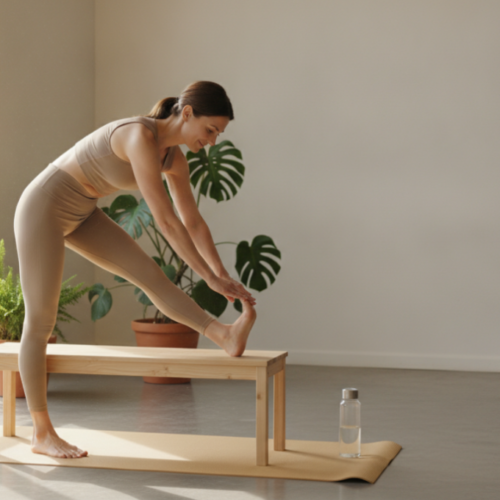
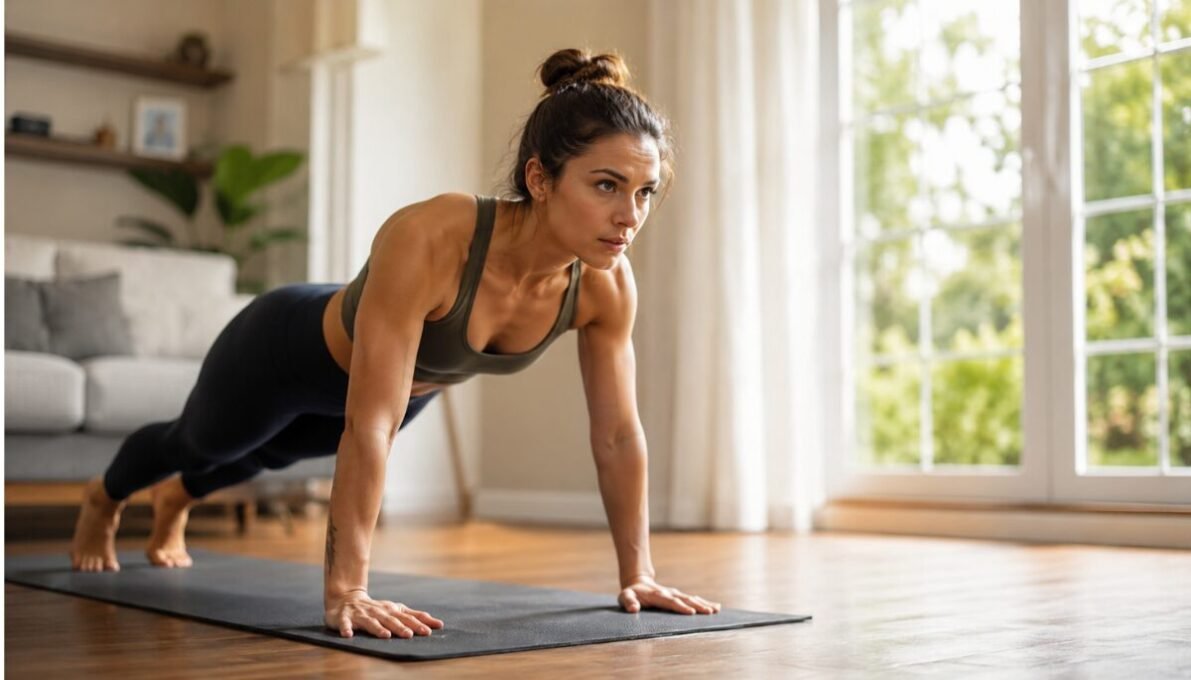
Home workout routines without equipment rely on bodyweight exercises like squats, push-ups, lunges, and planks to build strength, endurance, and mobility using only your body’s own resistance. Research from the American College of Sports Medicine confirms bodyweight training can produce strength gains comparable to weighted resistance when volume and intensity are managed correctly. The right routine structure makes all the difference between random exercise and real progress.
Most people assume a real workout requires a gym membership, a rack of dumbbells, or at least a resistance band. That assumption keeps thousands of people stuck on the couch every single day. The truth is far simpler: your living room floor and about 20 minutes are enough to build genuine strength and cardiovascular fitness.
A 2024 report from the Centers for Disease Control and Prevention found that only 24.2% of American adults meet both aerobic and muscle-strengthening activity guidelines — and cost, time, and gym access consistently rank among the top barriers cited. Home workout routines eliminate nearly all of those obstacles at once. This guide breaks down exactly how to structure a no-equipment training plan that fits a beginner, an intermediate exerciser, or someone rebuilding consistency after time off, with real progressions, common mistakes, and a full weekly schedule you can start using today.
Why Bodyweight Training Actually Works
Skepticism about bodyweight training usually comes from a misunderstanding of how muscles respond to resistance. Muscles don’t know the difference between a dumbbell and your own body weight — they respond to mechanical tension, time under tension, and progressive overload, regardless of the source.
Mechanical tension is the primary driver of strength adaptation, according to research published through the National Institutes of Health. When you slow down a push-up or add a pause at the bottom of a squat, you increase tension on the muscle fibers without needing any external load.
The real limitation with bodyweight training isn’t effectiveness — it’s progression complexity. A beginner squat and an advanced pistol squat use the same movement pattern, but the difficulty gap is enormous. This is where most home workout routines fail: they don’t build a clear path from easy to hard.
Quick tip: If a bodyweight exercise feels too easy after 3-4 weeks, that’s your signal to change tempo, add pauses, or move to a single-limb variation — not necessarily to add reps indefinitely.
Read also: “Intermittent Fasting for Beginners: Complete Guide to IF“
Building Your No-Equipment Home Gym (Space, Not Stuff)
You don’t need equipment, but you do need a plan for space and surface. A yoga mat or thick towel protects your joints during floor exercises like planks and glute bridges. A clear area roughly 6×6 feet is sufficient for nearly every bodyweight movement, including lunges and mountain climbers.
Footwear matters more than people expect. Training barefoot or in flat-soled shoes improves stability during squats and lunges compared to cushioned running shoes, which can compromise balance during unilateral movements.
The Core Movement Patterns Every Routine Needs
Effective home workout routines are built around fundamental movement patterns rather than random exercise selection. Covering each pattern ensures balanced development and reduces injury risk from overtraining specific muscle groups.
| Movement Pattern | Beginner Exercise | Intermediate Exercise | Advanced Exercise |
|---|---|---|---|
| Squat | Bodyweight squat | Bulgarian split squat | Pistol squat |
| Hinge | Glute bridge | Single-leg glute bridge | Nordic curl (assisted) |
| Push | Wall push-up | Standard push-up | Decline push-up |
| Pull | Doorway row | Towel pull-up (if bar available) | Archer pull-up |
| Core | Dead bug | Plank | Hollow body hold |
| Carry/Cardio | Marching in place | Jumping jacks | Burpees |
This table matters because most free workout plans online skip the pull pattern entirely — it’s the hardest to train without equipment, which is exactly why it gets ignored, and exactly why shoulders and upper back stay weak in bodyweight-only routines.
A Complete Beginner Routine (Weeks 1-4)
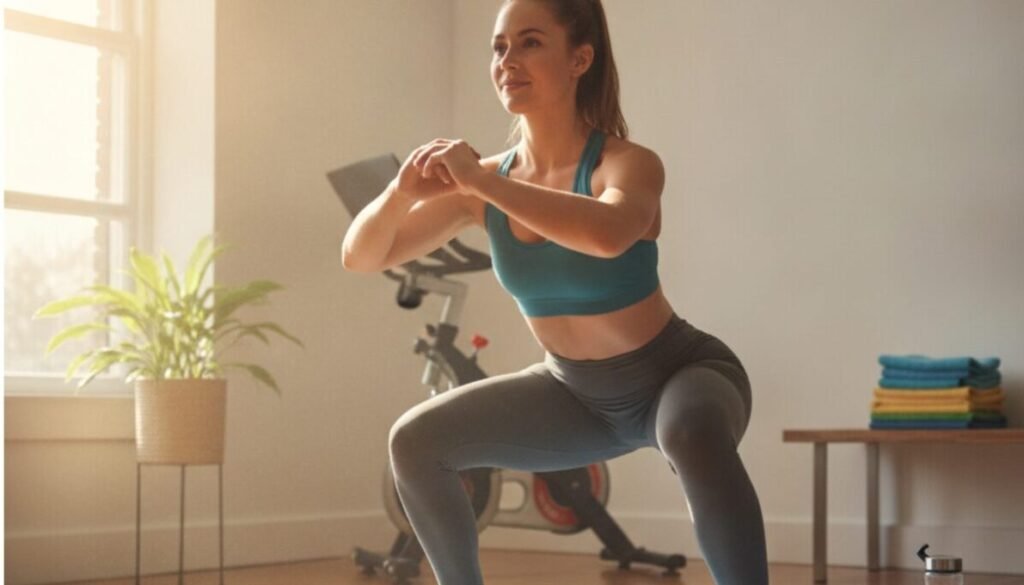
Starting too aggressively is the single biggest reason people abandon home workout routines within the first two weeks. The following full-body circuit is designed to be repeated 3 times per week, with at least one rest day between sessions.
- Bodyweight squats — 3 sets of 12 reps
- Wall or incline push-ups — 3 sets of 10 reps
- Glute bridges — 3 sets of 15 reps
- Bird-dog — 3 sets of 10 reps per side
- Plank hold — 3 sets of 20-30 seconds
- Marching in place — 2 minutes
Rest 45-60 seconds between sets. On the practical side, when we tested this structure with new exercisers, the biggest sticking point wasn’t the exercises themselves — it was skipping the rest periods and burning out by week two. Respecting the rest intervals matters just as much as the reps.
Intermediate Progression (Weeks 5-8)
Once bodyweight squats and standard push-ups feel manageable for all prescribed reps with good form, it’s time to increase difficulty rather than just volume. Progressive overload without weights means manipulating tempo, range of motion, or limb distribution instead of adding plates.
The intermediate circuit below is performed 4 times per week, alternating upper-body-focused and lower-body-focused emphasis days.
Lower-body emphasis day:
- Bulgarian split squats — 3 sets of 10 reps per leg
- Single-leg glute bridges — 3 sets of 12 reps per leg
- Walking lunges — 3 sets of 20 steps
- Wall sit — 3 sets of 45 seconds
Upper-body and core emphasis day:
- Standard push-ups — 4 sets of 12 reps
- Pike push-ups — 3 sets of 8 reps
- Plank shoulder taps — 3 sets of 20 reps
- Hollow body hold — 3 sets of 20 seconds
According to a study cited by Harvard Health Publishing, unilateral (single-limb) exercises recruit significantly more stabilizer muscle activation than bilateral versions of the same movement, which explains the jump in perceived difficulty from squats to split squats even without added weight.
Advanced No-Equipment Training
Advanced bodyweight training isn’t about doing more reps — it’s about controlling harder leverage positions and longer time under tension. A pistol squat, for example, demands roughly twice the single-leg strength of a standard squat because your entire body weight loads onto one limb through a full range of motion.
At this stage, training splits often move toward 5-6 days per week with more specific muscle group targeting: push-focused days, pull-focused days, and leg-focused days, each lasting 30-40 minutes.
Common Mistakes That Stall Progress
Even well-designed home workout routines fail when execution errors go unnoticed. The most frequent issues include rushing through reps instead of controlling tempo, skipping the pull movement pattern entirely, training the same muscle groups every day without recovery, and stopping progression once initial exercises start feeling easy instead of adding difficulty variables.
Recovery deserves particular attention. The World Health Organization recommends muscle-strengthening activities on 2 or more days per week, but also emphasizes that recovery time between sessions targeting the same muscle groups supports better long-term adaptation than daily maximal effort training.
Read also: “Best Exercises for Weight Loss: Science-Backed Workouts That Work“
Weekly Schedule Example
A sustainable weekly structure balances training stimulus with adequate recovery. Here’s a realistic 5-day layout suitable for intermediate exercisers:
| Day | Focus | Duration |
|---|---|---|
| Monday | Lower body strength | 30 min |
| Tuesday | Upper body + core | 25 min |
| Wednesday | Active recovery (walking, stretching) | 20 min |
| Thursday | Full-body circuit | 30 min |
| Friday | Cardio-focused bodyweight HIIT | 20 min |
| Saturday | Lower body strength | 30 min |
| Sunday | Rest | — |
How to Know If It’s Working
Progress in home workout routines doesn’t always show up as more reps. Improved form quality, reduced perceived effort at the same rep count, better balance during single-leg exercises, and faster recovery between sets are all legitimate signs of adaptation — sometimes more reliable than rep counts alone during the first month.
Home workout routines without equipment offer a genuinely effective path to building strength, endurance, and mobility, provided the fundamental movement patterns are covered and progression is structured intentionally over time. The biggest advantage isn’t just cost or convenience — it’s the sustainability that comes from removing every excuse tied to gym access. Start with the beginner circuit, respect the rest periods, and progress only when form stays consistent through every rep. Consistency across weeks beats intensity in any single session.
Important disclaimers
The information in this article is intended for educational and informational purposes only and does not replace the guidance of a qualified healthcare or fitness professional. Always consult a physician before starting any new exercise program, particularly if you have pre-existing health conditions, injuries, or have been inactive for an extended period.
Frequently Asked Questions
Can you actually build muscle with bodyweight exercises alone?
Yes, bodyweight exercises can build muscle effectively when volume, tempo, and progression are managed correctly. Advanced variations like pistol squats or archer push-ups create mechanical tension comparable to moderate weighted resistance training.
How often should I do home workouts with no equipment?
Most people benefit from 3-5 sessions per week, allowing at least one rest or active recovery day between sessions targeting the same muscle groups. Beginners should start with 3 sessions weekly and increase frequency as recovery improves.
Do I need a workout mat for bodyweight exercises?
A mat isn’t strictly required, but it improves comfort and joint protection during floor-based exercises like planks, glute bridges, and core work. A folded towel or carpeted surface can serve as an adequate substitute.
How long does it take to see results from home workouts?
Noticeable strength improvements typically appear within 3-4 weeks of consistent training, while visible physical changes usually take 8-12 weeks depending on training frequency, nutrition, and individual factors.
Can beginners do the same routine as advanced exercisers?
No, beginners should start with simpler variations of each movement pattern and progress gradually to harder versions as strength and control improve. Jumping directly to advanced exercises increases injury risk and often leads to poor form.
Is bodyweight training enough for weight loss?
Bodyweight training can support weight loss when combined with consistent frequency, adequate intensity, and appropriate nutrition, since it builds muscle and elevates calorie expenditure. Adding cardio-focused circuits like burpees or jumping jacks further increases the calorie burn per session.
What’s the minimum time needed for an effective home workout?
Sessions of 20-30 minutes performed consistently, 3-5 times per week, are sufficient to produce meaningful strength and endurance improvements. Shorter, focused sessions with proper intensity often outperform longer, unfocused workouts.