
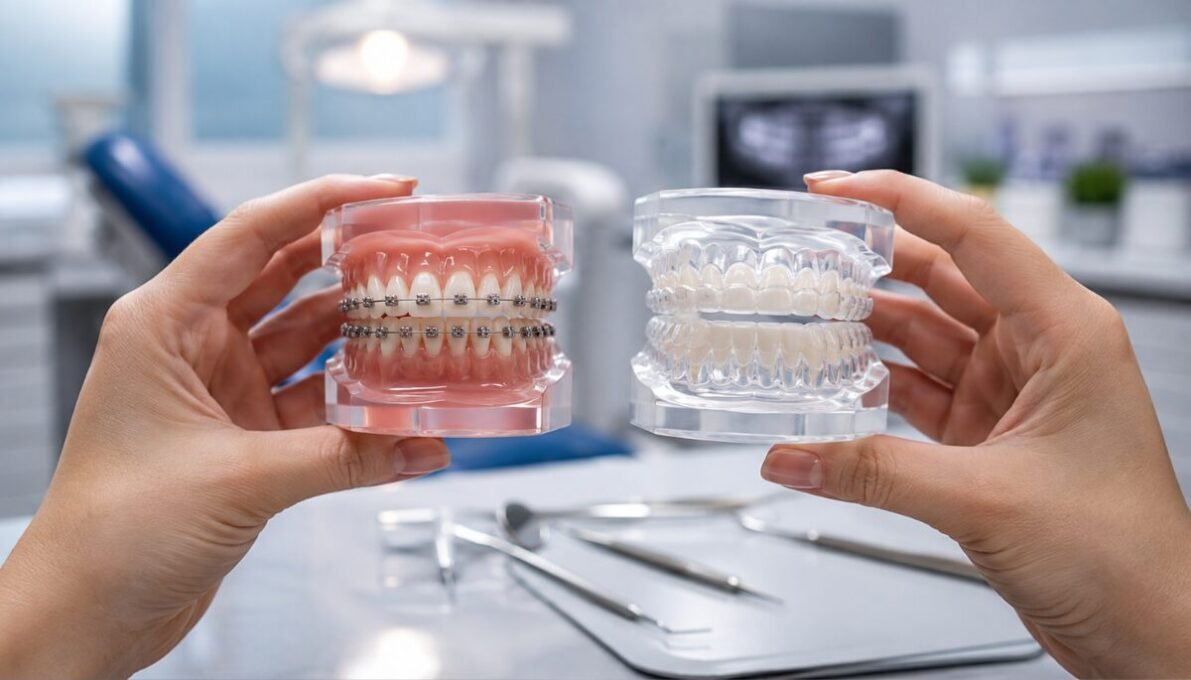
Orthodontic treatment options in 2026 fall into two main categories: traditional braces and clear aligners like Invisalign. Braces use metal or ceramic brackets bonded to teeth, while Invisalign relies on removable, custom-fitted plastic trays. Both correct misalignment and bite issues, but they differ significantly in cost, comfort, treatment time, and daily maintenance.
Choosing between braces and Invisalign can feel overwhelming, especially when every orthodontist seems to recommend something different. Straight teeth aren’t just about appearance; misaligned bites contribute to jaw pain, uneven wear, and even speech difficulties over time. According to the American Association of Orthodontists, more than 4 million people in the United States are currently undergoing some form of orthodontic treatment, and adults now make up nearly one in four of those patients.
This guide breaks down how each orthodontic treatment option works, what they cost, how long they take, and which situations call for one over the other. Whether the priority is speed, discretion, or budget, understanding the mechanics behind each approach makes it much easier to have a productive conversation with an orthodontist rather than simply nodding along to a sales pitch.
What Counts as an Orthodontic Treatment Option
Orthodontic treatment options generally split into fixed appliances and removable appliances. Fixed appliances, like traditional metal or ceramic braces, stay bonded to the teeth for the entire treatment period. Removable appliances, like Invisalign and similar clear aligner systems, can be taken out for eating, brushing, and special occasions.
There’s also a growing middle category in 2026: hybrid systems that combine aligner technology with small attachments or auxiliary devices to handle more complex tooth movements that aligners alone struggle to correct. Orthodontists increasingly use digital scanning and AI-assisted treatment planning to map out tooth movement before any appliance is placed, regardless of which system is chosen.
Orthodontic treatment options exist on a spectrum from fully fixed to fully removable, and the right choice depends less on personal preference and more on the specific bite problem being corrected.
Read also: “Teeth Sensitivity: Causes and Effective Treatment Options“
Traditional Metal Braces: How They Work and Who They’re Best For
Metal braces consist of brackets bonded to each tooth, connected by an archwire that gradually applies pressure to shift teeth into position. An orthodontist adjusts the wire tension every four to eight weeks, and small elastic bands (ligatures) hold the wire in place against each bracket.
This system has been refined for decades and remains the most predictable option for complex cases. Severe crowding, significant bite misalignment, or cases requiring tooth rotation and vertical movement often respond better to braces than to aligners, since the fixed wire applies continuous, precisely controlled force in three dimensions.
Braces typically require 18 to 24 months of treatment for moderate to complex cases, according to data compiled by the American Dental Association. Patients wear them full-time, with no ability to remove them for meals, which eliminates the compliance risk that comes with removable systems.
The tradeoff is visibility and some initial discomfort. Brackets and wires can cause soreness for the first few days after each adjustment, and certain foods (sticky candy, popcorn, hard nuts) need to be avoided to prevent damage. Ceramic braces, which use tooth-colored brackets, offer a less noticeable alternative while keeping the same mechanical advantages as metal braces.
Invisalign and Clear Aligners: How the Modern Alternative Works
Invisalign uses a series of custom, clear plastic trays, each designed to move teeth incrementally toward their final position. Patients switch to a new tray roughly every one to two weeks, with each set applying slightly more pressure than the last. Treatment starts with a 3D digital scan of the mouth, which allows the orthodontist to map out the entire tooth-movement sequence before treatment even begins.
Unlike braces, aligners are removable, which means patients take them out to eat, brush, and floss. This convenience comes with a catch: aligners need to be worn 20 to 22 hours per day to work effectively, and inconsistent wear is the most common reason treatment takes longer than projected.
Invisalign tends to work best for mild to moderate misalignment, gaps, and minor bite issues. Severe crowding or complex rotations can sometimes be managed with newer aligner technology and auxiliary attachments, but many orthodontists still recommend braces for these cases due to the superior control fixed appliances offer over difficult tooth movements.
Clear aligners like Invisalign are custom-molded plastic trays that gradually shift teeth without brackets or wires, offering a nearly invisible and removable alternative to traditional braces for people with mild to moderate alignment issues.
Average treatment time with Invisalign ranges from 6 to 18 months, depending on case complexity, based on clinical outcomes published in the National Institute of Dental and Craniofacial Research database.
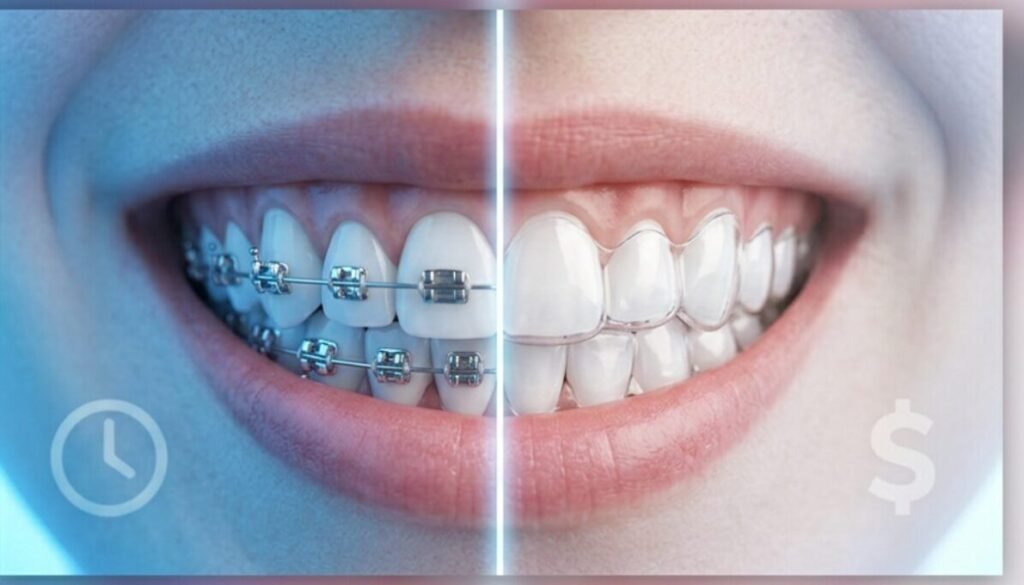
Braces vs Invisalign: Side-by-Side Comparison
| Factor | Traditional Braces | Invisalign / Clear Aligners |
|---|---|---|
| Visibility | Highly visible (unless ceramic) | Nearly invisible |
| Removability | Fixed, cannot be removed | Removable for eating/brushing |
| Average treatment time | 18–24 months | 6–18 months |
| Average cost (US) | $3,000–$7,500 | $3,500–$8,500 |
| Best for | Complex bite issues, severe crowding | Mild to moderate misalignment |
| Diet restrictions | Yes (sticky, hard foods) | None (removed before eating) |
| Compliance required | Low (fixed, no patient action needed) | High (must wear 20–22 hrs/day) |
| Oral hygiene | More challenging around brackets | Easier (trays removed for brushing) |
This comparison highlights a core tradeoff: braces demand less day-to-day discipline but more lifestyle adjustment, while aligners offer convenience and discretion but only work if the patient is consistent about wear time.
Other Orthodontic Options Worth Considering
Beyond the two most common systems, several other appliances address specific needs or preferences.
- Ceramic braces: Function identically to metal braces but use tooth-colored or clear brackets, making them less noticeable while retaining the mechanical control needed for complex cases.
- Lingual braces: Attach to the back of the teeth rather than the front, making them completely invisible from the outside, though they tend to cost more and can take longer to adjust to speech-wise.
- ClearCorrect and other aligner brands: Function similarly to Invisalign, using a series of removable trays, often at a lower price point but with a smaller range of case complexity they can address.
- Retainers (post-treatment): Not a primary treatment, but essential after braces or aligners to prevent teeth from shifting back, typically worn nightly for years after active treatment ends.
Choosing among these often comes down to how much visibility a patient can tolerate versus how complex their bite correction needs to be.
How to Choose the Right Orthodontic Treatment Option
Selecting between braces, Invisalign, or another system depends on a handful of practical factors that an orthodontist evaluates during the initial consultation.
- Severity of misalignment: Complex rotations or severe crowding usually point toward braces; mild gaps or minor crowding often work well with aligners.
- Age and lifestyle: Teenagers and patients who may forget to wear removable trays consistently often do better with fixed braces.
- Budget and insurance coverage: Dental insurance plans vary widely in how much orthodontic treatment they cover, so it’s worth confirming coverage before committing to either option.
- Aesthetic priorities: Patients in client-facing careers or those simply uncomfortable with visible metal often lean toward ceramic braces, lingual braces, or aligners.
- Commitment to compliance: Aligners only work if worn as directed; patients who know they’ll struggle with that discipline may get better results from a fixed appliance.
An orthodontist’s clinical assessment, including X-rays and digital scans, ultimately determines which option will produce the most predictable and efficient result for a given bite pattern.
Read also: “Bad Breath Causes: Why It Happens and How to Fix It“
Cost and Insurance Considerations
Orthodontic treatment costs vary by region, provider, and case complexity, but national averages provide a useful benchmark. Metal braces generally cost between $3,000 and $7,500 in the United States, while Invisalign treatment tends to run slightly higher, between $3,500 and $8,500, according to pricing data tracked by the American Association of Orthodontists.
Many dental insurance plans cover a portion of orthodontic treatment, often up to a lifetime maximum benefit rather than a percentage of total cost. Flexible spending accounts (FSAs) and health savings accounts (HSAs) can also offset out-of-pocket expenses, and many orthodontic offices offer in-house payment plans that spread costs over the treatment period.
Orthodontic treatment options in 2026 offer more flexibility than ever, but the fundamental choice still comes down to matching the appliance to the specific bite problem, lifestyle, and budget involved. Braces remain the most reliable choice for complex corrections, while Invisalign and similar aligners offer a discreet, removable alternative for milder cases. Neither option is universally “better”; the right one depends entirely on individual dental needs. Anyone weighing these choices should bring specific questions about treatment time, cost, and expected results into their next orthodontic consultation to get a personalized recommendation.
Important disclaimers
The information in this article is for educational and informational purposes only and does not replace evaluation or guidance from a licensed dental or orthodontic professional. Always consult a qualified orthodontist or dentist before making decisions about your treatment or diagnosis.
Frequently Asked Questions
Is Invisalign as effective as braces?
For mild to moderate misalignment, Invisalign is generally as effective as braces. For severe crowding, significant bite issues, or complex rotations, traditional braces typically produce more predictable results due to their continuous, fixed force application.
How long does orthodontic treatment usually take?
Treatment time ranges from 6 to 24 months depending on the severity of the case and the appliance used. Aligners often finish faster for mild cases, while braces may take longer for complex corrections.
Can adults get braces or Invisalign?
Yes, adults make up a significant and growing portion of orthodontic patients. Age does not prevent tooth movement, though healing and treatment time can vary slightly compared to younger patients.
Do braces hurt more than Invisalign?
Braces tend to cause more soreness immediately after adjustments due to wire tightening, while aligners cause mild discomfort when switching to a new tray. Neither option involves significant ongoing pain once teeth adjust to the pressure.
Is Invisalign more expensive than braces?
Invisalign is often slightly more expensive than traditional metal braces, though pricing overlaps significantly depending on case complexity and provider. Ceramic and lingual braces can sometimes cost more than both standard options.
What happens if I don’t wear my retainer after treatment?
Teeth can gradually shift back toward their original position without consistent retainer use, potentially undoing months or years of orthodontic work. Most orthodontists recommend nightly retainer wear indefinitely after active treatment ends.
Can I switch from braces to Invisalign mid-treatment?
In some cases, yes, particularly once major tooth movements have already been achieved with braces. This decision requires an orthodontist’s evaluation to confirm the remaining corrections are suitable for aligner treatment.