
Collagen supplements are protein products, usually in powder or capsule form, designed to replace the collagen the body naturally loses with age. They typically come as hydrolyzed collagen peptides, which are broken down for easier absorption. Most people take them for skin elasticity, joint comfort, and bone support, though results vary by type and dosage.
Why Your Body’s Collagen Matters More Than You Think
Collagen is the most abundant protein in the human body, making up roughly a third of total protein content. It forms the structural scaffolding of skin, tendons, ligaments, cartilage, and bones, which is why its gradual decline after age 20 becomes noticeable in ways people don’t always connect to collagen: thinner skin, stiffer joints, slower wound healing.
That decline isn’t gradual and steady for everyone. Collagen production drops by an estimated 1% per year starting in the mid-20s, and the drop accelerates sharply during menopause due to falling estrogen levels, according to research summarized by the National Institutes of Health Office of Dietary Supplements. This is the biological reason collagen supplements gained traction, not just marketing hype, though the evidence behind them is more nuanced than most product labels suggest.
This guide breaks down what collagen supplements actually do, which types have real research behind them, and how to use them without wasting money on the wrong product.
What Are Collagen Supplements, Exactly?
Collagen supplements are almost always hydrolyzed collagen, also called collagen peptides. This means the large collagen protein molecule has been broken into smaller fragments through a process called hydrolysis, which makes it easier for the digestive system to absorb compared to whole collagen or gelatin.
Once ingested, these peptides don’t travel directly to your skin or joints as intact collagen. Instead, they’re broken down into amino acids and smaller peptides that appear to signal fibroblasts, the cells responsible for producing your body’s own collagen, elastin, and hyaluronic acid. This mechanism, sometimes called the “peptide signaling effect,” is one of the more plausible explanations for why supplementation shows measurable effects in clinical trials.
Types of Collagen and What Each One Targets
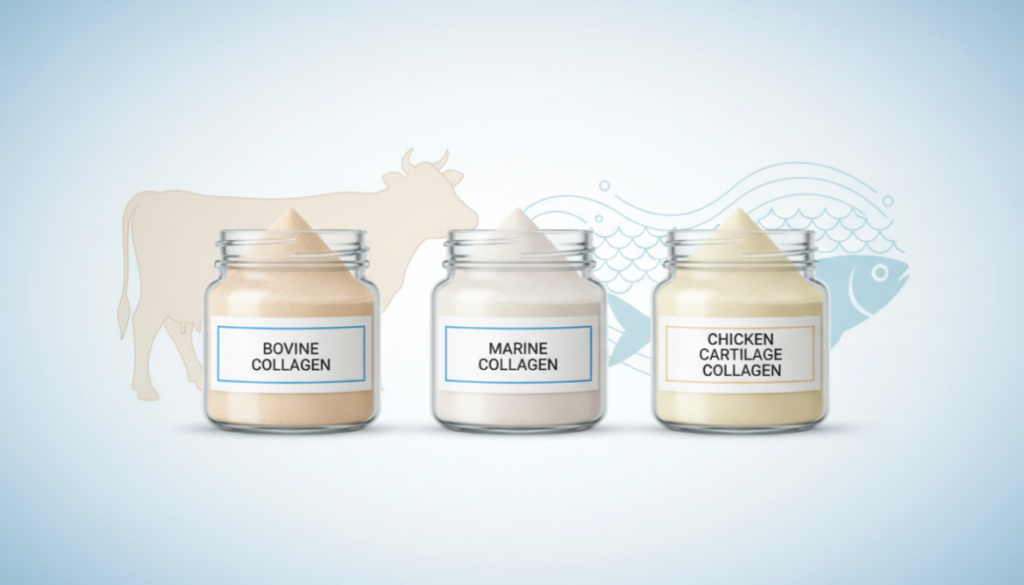
Not all collagen supplements are interchangeable. The source and collagen type determine which body systems they’re most likely to support.
| Type | Main Source | Primary Target | Notes |
|---|---|---|---|
| Type I | Bovine, marine | Skin, bones, tendons | Most common in supplements; makes up 90% of body’s collagen |
| Type II | Chicken cartilage | Joint cartilage | Often sold as undenatured collagen (UC-II) for arthritis support |
| Type III | Bovine, marine | Skin elasticity, blood vessels | Usually paired with Type I in “multi-collagen” blends |
| Marine collagen | Fish skin/scales | Skin hydration | Smaller peptide size, marketed for higher bioavailability |
| Bovine collagen | Cow hide/bone | Skin, joints, gut lining | Most researched and widely available source |
Marine collagen is essentially fish-derived Type I collagen, prized for its smaller molecular size, which some studies suggest may improve absorption, though direct comparative data against bovine collagen remains limited.
Read also: “Thyroid Health Guide: Warning Signs to Watch For“
What the Research Actually Shows
This is where it’s worth separating marketing claims from documented outcomes.
Skin. A 2014 study published in Skin Pharmacology and Physiology found that women who took 2.5–5g of hydrolyzed collagen daily for eight weeks showed measurably improved skin elasticity compared to a placebo group. A broader 2021 review of 19 studies, most involving doses between 1g and 10g daily over 4 to 12 weeks, reported consistent improvements in skin hydration, elasticity, and wrinkle depth, according to findings indexed on PubMed. The effect size was modest but statistically significant across most trials.
Joints. A 2019 meta-analysis in the journal Nutrients examined collagen peptide supplementation in people with joint discomfort or mild osteoarthritis and found reduced pain scores and improved joint function after 3 to 6 months of consistent use. Undenatured Type II collagen, taken in much smaller doses (around 40mg daily), showed a different but complementary mechanism, working through immune modulation rather than structural replacement.
Bone density. In a often-cited 2018 study also published in Nutrients, postmenopausal women who took 5g of collagen peptides daily for 12 months showed increased bone mineral density compared to a placebo group, alongside favorable changes in bone formation markers. This is one of the few collagen studies with a long enough duration to speak meaningfully to bone health outcomes.
Gut and muscle. Evidence here is thinner. Some smaller trials suggest collagen peptides combined with resistance training may support muscle mass in older adults, but the data isn’t as robust as the skin and joint research. Claims about “gut healing” from collagen remain largely anecdotal and lack the large-scale trials needed to confirm a direct mechanism.
Quick definition: Hydrolyzed collagen refers to collagen protein broken into smaller peptide chains through enzymatic processing, which increases digestibility and absorption compared to unprocessed collagen or gelatin.
How to Choose a Collagen Supplement
Not every product on the shelf delivers what it promises. A few practical filters make the decision easier:
- Check the dose per serving. Most clinical benefits were observed at 2.5g to 15g per day, depending on the goal. Products with less than 2.5g per serving are unlikely to match study results.
- Look for third-party testing. Since supplements aren’t reviewed by the FDA before hitting shelves, certifications from NSF or USP indicate independent quality verification.
- Match the type to your goal. Type I and III for skin and general support; Type II or UC-II specifically for joint-related concerns.
- Consider the source if you have dietary restrictions. Bovine, marine, and porcine collagen all come from animal byproducts, so none are suitable for vegans or vegetarians. No plant-based product contains actual collagen, since collagen is exclusively an animal protein.
- Check for added vitamin C. Vitamin C is a required cofactor for collagen synthesis in the body, so formulas that include it may support better utilization of the supplement.

How to Take Collagen Supplements for Best Results
Consistency matters more than timing with collagen. Based on how the clinical trials were structured, a reasonable approach looks like this:
- Start with 2.5g to 5g daily if your primary goal is skin, or up to 10-15g for joint or bone support, based on studied dosages.
- Take it consistently at the same time each day, mixed into coffee, smoothies, or water, since collagen peptides are largely flavorless and dissolve easily.
- Pair it with a source of vitamin C, such as citrus fruit or a fortified drink, to support the body’s synthesis process.
- Commit to at least 8 to 12 weeks before evaluating results, since visible skin changes typically require that timeframe based on trial durations.
- Reassess after 3 months and adjust dosage or type based on which benefit (skin, joints, bone) you’re prioritizing.
Tip: Collagen peptides are heat-stable, so they can be added to hot coffee or soup without breaking down, unlike some other protein powders.
Read also: “Turmeric Health Benefits: The Golden Spice Guide“
Potential Side Effects and Who Should Be Cautious
Collagen supplements are generally considered safe for most healthy adults, with mild digestive discomfort, bloating, or a lingering aftertaste (more common with marine sources) being the most commonly reported issues. People with shellfish or fish allergies should avoid marine collagen specifically, while those with beef or pork allergies should check the source of bovine or porcine formulas. Anyone managing kidney conditions should be mindful of protein intake changes, since collagen supplements do add to daily protein load.
Common Myths About Collagen Supplements
A few misconceptions persist even in otherwise well-informed circles. One is that collagen supplements directly “replace” the collagen in your skin, when in fact the peptides act more as signals that stimulate your own collagen production rather than being deposited intact. Another is that all collagen types work the same way, when the research clearly shows Type II behaves through a distinct immune pathway compared to Type I and III’s structural role. A third myth is that higher doses always mean better results. Most studies used moderate, consistent dosing rather than mega-doses, and there’s no strong evidence that exceeding 15g daily produces proportionally greater benefits.
Bringing It All Together
Collagen supplements aren’t a miracle fix, but the clinical research on hydrolyzed collagen peptides for skin elasticity, joint comfort, and bone density is more substantial than for most trending supplements. The key is matching the collagen type to your actual goal, sticking with a dose in the studied range, and giving it the 8 to 12 weeks most trials required to show measurable change. Choosing a third-party tested product and pairing it with vitamin C rounds out a reasonable, evidence-informed approach to using collagen supplements.
Important disclaimers
The information in this article is for educational and informational purposes only and does not replace the guidance of a qualified healthcare professional. Always consult a doctor before starting any new supplement, especially if you have existing health conditions, allergies, or take other medications.
Frequently Asked Questions
Do collagen supplements actually work?
Clinical studies show measurable improvements in skin elasticity, hydration, and joint comfort with consistent use of hydrolyzed collagen peptides over 8 to 12 weeks, though individual results vary based on dose, type, and baseline collagen levels.
How long does it take to see results from collagen supplements?
Most clinical trials observed noticeable changes in skin elasticity and hydration after 8 to 12 weeks of daily use, while bone density improvements required consistent use for up to 12 months.
What is the best time of day to take collagen?
There’s no clinically proven “best” time; consistency matters more than timing, so choosing a convenient time you can maintain daily, such as with morning coffee, is the most practical approach.
Can vegetarians or vegans take collagen supplements?
No, all collagen supplements are derived from animal sources such as bovine, marine, or porcine tissue, since collagen itself is exclusively an animal protein with no direct plant-based equivalent.
What’s the difference between collagen and collagen peptides?
Collagen peptides are hydrolyzed collagen, meaning the protein has been broken into smaller chains for easier digestion and absorption, while unprocessed collagen (like gelatin) is less bioavailable in supplement form.
Are there side effects to taking collagen supplements?
Most people tolerate collagen supplements well, with mild digestive upset or an aftertaste being the most commonly reported effects; those with fish, shellfish, beef, or pork allergies should check the collagen source before use.
Which type of collagen is best for joint pain?
Type II collagen, particularly undenatured Type II (UC-II), has the most research supporting joint-related benefits, working through a different immune-modulating mechanism compared to Type I and III collagen.

My relationship with health and wellness began on a personal level, looking for practical ways to improve my own routine: more movement, more mindful eating, and basic oral care habits that, over time, made a real difference in my quality of life. It was this ongoing process of learning — testing, researching, and adjusting — that motivated me to share what I learn with others on the same journey.