

B vitamins importance comes from their direct role in turning food into usable energy, supporting brain and nerve function, and forming healthy red blood cells. There are eight distinct B vitamins, most of which the body cannot store for long, which is why consistent daily intake through food or supplements matters for lasting health.
Most people know vitamins are “good for you,” but few understand why B vitamins specifically show up on almost every multivitamin label and why doctors check for them when patients complain of constant tiredness. The truth is that these eight nutrients work behind the scenes in nearly every cell, converting carbohydrates, fats, and proteins into the fuel your brain and muscles run on. According to the National Institutes of Health Office of Dietary Supplements, an estimated 6% of U.S. adults over 60 have a vitamin B12 deficiency, and the number rises with age due to reduced stomach acid production needed for absorption.
This article breaks down what each B vitamin does, how to recognize the early warning signs of deficiency, which foods deliver the most per serving, and who needs to pay closer attention to their intake. By the end, you will know exactly how to support your energy, mood, and long-term health through this often-overlooked group of nutrients.
What Are B Vitamins and Why Do They Matter?
The B vitamin group is not a single nutrient but a family of eight water-soluble compounds, each with a distinct job. Because they dissolve in water rather than fat, the body cannot stockpile most of them in tissue the way it does with vitamins A, D, E, and K. Any excess is typically excreted in urine within a day or two.
Vitamin B complex refers to eight essential nutrients—thiamine, riboflavin, niacin, pantothenic acid, vitamin B6, biotin, folate, and vitamin B12—that work together to support energy metabolism, nervous system function, and cell production.
This is precisely why deficiency can develop faster than with fat-soluble vitamins if intake drops for even a few weeks. Each vitamin acts as a coenzyme, meaning it helps activate specific enzymes that drive chemical reactions throughout the body, from breaking down glucose to synthesizing DNA.
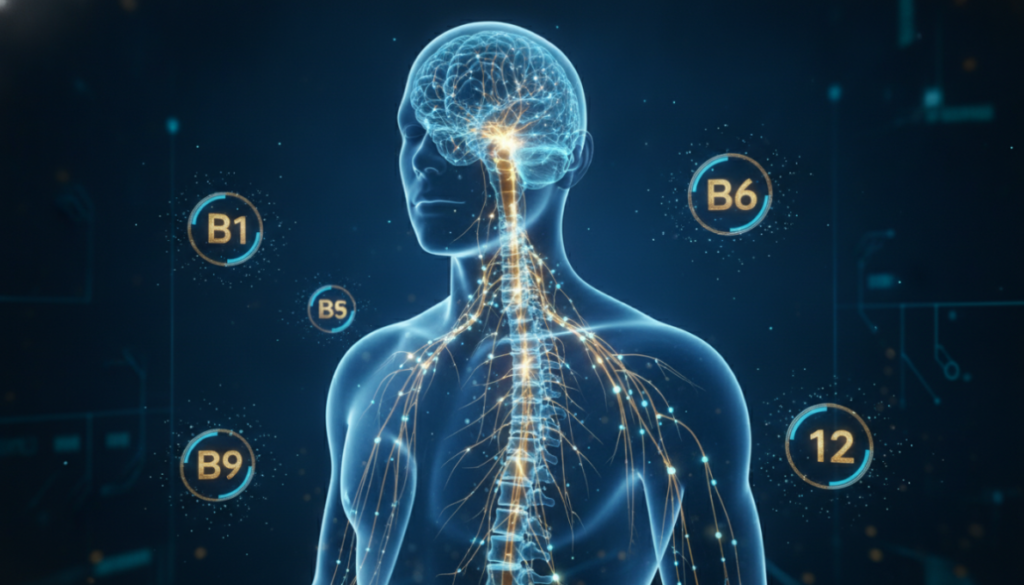
The 8 B Vitamins and Their Specific Roles
Each B vitamin has a specialized function, and understanding the differences helps explain why a single “B complex” supplement can address such a wide range of symptoms.
| Vitamin | Also Known As | Primary Function | Common Food Sources |
|---|---|---|---|
| B1 | Thiamine | Converts carbs into energy; supports nerve function | Pork, whole grains, legumes |
| B2 | Riboflavin | Supports energy production and cell growth | Eggs, dairy, lean meats |
| B3 | Niacin | Aids DNA repair and metabolism | Poultry, fish, peanuts |
| B5 | Pantothenic acid | Synthesizes coenzyme A for fat metabolism | Avocado, mushrooms, yogurt |
| B6 | Pyridoxine | Supports brain development and immune function | Chickpeas, salmon, potatoes |
| B7 | Biotin | Supports hair, skin, and nail health | Egg yolks, nuts, sweet potatoes |
| B9 | Folate | Essential for cell division and fetal development | Leafy greens, citrus, beans |
| B12 | Cobalamin | Forms red blood cells and maintains nerve tissue | Meat, fish, dairy, fortified cereal |
The Harvard T.H. Chan School of Public Health notes that B12 is found almost exclusively in animal products, which is why plant-based eaters face a higher risk of deficiency without fortified foods or supplementation.
Read also: “Digestive Health Tips: Complete 2026 Guide“
Signs and Symptoms of B Vitamin Deficiency
Deficiency symptoms often overlap between the different B vitamins, which makes self-diagnosis tricky. Fatigue that does not improve with rest is usually the first sign people notice, followed by changes in mood, concentration, or skin.
A person with low B6 or B12 may experience tingling in the hands and feet, a symptom that stems from nerve damage caused by insufficient myelin production. Low folate during pregnancy carries more serious consequences, including a higher risk of neural tube defects in the developing fetus, which is why prenatal vitamins are formulated with elevated folate levels.
Watch for these common indicators that intake may be insufficient:
- Persistent fatigue or low energy despite adequate sleep
- Pale skin or shortness of breath (linked to B12 or folate-related anemia)
- Tingling, numbness, or muscle weakness in the extremities
- Mouth sores, cracked lips, or a swollen, sore tongue
- Mood changes, irritability, or difficulty concentrating
- Hair thinning or brittle nails (associated with low biotin)
None of these symptoms confirms a specific deficiency on their own, since conditions like thyroid disorders or iron deficiency produce similar patterns. A blood test remains the only reliable way to confirm which vitamin, if any, is running low.

Best Food Sources of B Vitamins
Whole foods generally deliver B vitamins alongside fiber, minerals, and other nutrients that work synergistically, which is one reason nutritionists favor food-first approaches over supplements when possible.
- Animal proteins — meat, poultry, fish, and eggs cover thiamine, riboflavin, niacin, B6, and B12 in well-absorbed forms.
- Dairy products — milk, cheese, and yogurt contribute riboflavin, B12, and pantothenic acid.
- Legumes and beans — chickpeas, lentils, and black beans are strong sources of folate, thiamine, and B6.
- Leafy greens — spinach, kale, and romaine lettuce are among the richest natural sources of folate.
- Whole grains and fortified cereals — many breakfast cereals in the U.S. are fortified specifically to help prevent folate and B12 shortfalls.
- Nuts and seeds — sunflower seeds and almonds provide meaningful amounts of B7 and B5.
People following vegan or vegetarian diets should pay particular attention to B12, since plants do not produce this vitamin naturally. Fortified nutritional yeast, plant milks, and B12 supplements are the standard workaround recommended by dietitians.
Who Is at Higher Risk of B Vitamin Deficiency?
Certain groups face a structurally higher risk of running low, regardless of how carefully they eat.
| Risk Group | Vitamin(s) Affected | Why the Risk Is Higher |
|---|---|---|
| Adults over 50 | B12 | Reduced stomach acid limits absorption |
| Pregnant individuals | Folate (B9) | Higher demand for fetal cell growth |
| Vegans and vegetarians | B12 | Absent from plant foods |
| People with Crohn’s or celiac disease | B12, folate | Impaired nutrient absorption in the gut |
| Heavy alcohol users | B1, B6, folate | Alcohol interferes with absorption and storage |
| People taking metformin or long-term PPIs | B12 | Medications reduce absorption efficiency |
The Mayo Clinic points out that older adults are often advised to get B12 from fortified foods or supplements rather than relying solely on naturally occurring sources, since the crystalline form in supplements is easier to absorb when stomach acid production declines with age.
B Vitamins and Energy: Separating Fact from Myth
B vitamins are frequently marketed as instant energy boosters, and energy drink labels lean heavily on this association. The reality is more nuanced: B vitamins are required for the metabolic pathways that convert food into ATP, the molecule cells use for energy, but taking extra B vitamins beyond what the body needs does not produce a noticeable energy surge in someone who is not deficient.
Vitamin B supplements only restore normal energy metabolism in people who have a genuine deficiency; in adequately nourished individuals, extra B vitamins are simply excreted rather than boosting performance.
This distinction matters for anyone tempted to treat chronic fatigue with high-dose B complex pills without first checking whether a deficiency actually exists. A blood panel ordered by a healthcare provider remains the most accurate way to determine if supplementation will make a measurable difference.
Read also: “Collagen Supplements: Benefits, Types, and How to Choose“
How Much Do You Need? Daily Recommended Intake
Recommended amounts vary by age, sex, and life stage, with pregnancy and lactation typically raising the targets for folate and B12.
| Vitamin | Adult Men (RDA) | Adult Women (RDA) |
|---|---|---|
| B1 (Thiamine) | 1.2 mg | 1.1 mg |
| B2 (Riboflavin) | 1.3 mg | 1.1 mg |
| B3 (Niacin) | 16 mg NE | 14 mg NE |
| B6 | 1.3–1.7 mg | 1.3–1.5 mg |
| B9 (Folate) | 400 mcg DFE | 400 mcg DFE |
| B12 | 2.4 mcg | 2.4 mcg |
These figures come from established dietary reference intakes tracked by the NIH Office of Dietary Supplements, and they represent minimums needed to prevent deficiency in a healthy adult population, not necessarily optimal levels for every individual circumstance.
B vitamins importance extends far beyond a single function: these eight nutrients work together to convert food into energy, protect nerve health, support red blood cell formation, and enable healthy fetal development during pregnancy. Because they are water-soluble and not stored long-term, the body depends on a steady daily supply from food or, when needed, targeted supplementation. Paying attention to risk factors like age, diet type, and certain medications can help catch a shortfall before symptoms like fatigue or tingling become noticeable. If this breakdown clarified how B vitamins support your body, consider checking your own diet against the food sources listed above or exploring more nutrition guides on this site.
Important disclaimers
The information in this article is for educational and informational purposes only and does not replace the evaluation or guidance of a qualified healthcare professional. Always consult a doctor before making decisions about your diagnosis, treatment, or supplement use.
Frequently Asked Questions
What happens if you don’t get enough B vitamins?
Insufficient B vitamin intake can lead to fatigue, anemia, nerve tingling, mouth sores, and in the case of low folate during pregnancy, an increased risk of birth defects. Symptoms vary depending on which specific B vitamin is low.
Can you take too many B vitamins?
Because B vitamins are water-soluble, excess amounts are generally flushed out through urine rather than stored. However, very high doses of certain B vitamins, particularly B6, have been linked to nerve damage with long-term overuse.
Which B vitamin is most important for energy?
No single B vitamin works alone for energy production; B1, B2, B3, B5, B6, and B7 all participate in the metabolic pathways that convert carbohydrates, fats, and proteins into usable cellular energy.
Do vegans need to supplement B12?
Yes, vitamin B12 occurs almost exclusively in animal products, so vegans typically need fortified foods or a B12 supplement to avoid deficiency over time.
How long does it take to correct a B vitamin deficiency?
Mild deficiencies often improve within a few weeks of increased dietary intake or supplementation, while more severe or long-standing B12 deficiencies may require months of treatment, sometimes through injections under medical supervision.
Is it better to get B vitamins from food or supplements?
Whole foods deliver B vitamins alongside fiber and other nutrients that support absorption, making them the preferred source when possible; supplements are useful for people with documented deficiencies, dietary restrictions, or absorption issues.
Can stress deplete B vitamins?
Chronic physical or psychological stress can increase the body’s use of certain B vitamins, particularly B1, B6, and B12, which is one reason “stress support” supplements often include a B complex formula.