A portion control guide teaches you how to match the amount of food you eat to your body’s actual energy needs, without restrictive dieting. It relies on visual cues, simple tools, and consistent habits rather than calorie counting. Mastering portion sizes helps prevent overeating, supports steady energy levels, and makes healthy eating sustainable long-term.
Most people don’t overeat because they lack willpower — they overeat because plates got bigger, packaging got denser, and eyes learned to trust size instead of hunger. Restaurant portions in the United States have grown noticeably over the past few decades, and home dinnerware has followed the same trend. The result is a quiet shift: what used to be a large serving now looks normal, and what used to be normal now looks small.
This is where a solid understanding of portion sizes becomes practical rather than theoretical. You don’t need a food scale on your kitchen counter for the rest of your life, and you don’t need to memorize gram-per-gram nutrition labels. What actually works is learning a handful of visual anchors, understanding why your brain misjudges quantity, and building repeatable habits around meals. That’s exactly what this guide walks through, step by step, so portion control stops feeling like a chore and starts feeling like second nature.
What Portion Control Actually Means
Portion control is the practice of eating an amount of food appropriate to your hunger and energy needs, as opposed to eating based on what’s placed in front of you. It’s different from a “serving size,” which is a standardized measurement used on nutrition labels for comparison purposes — not necessarily what you should eat in one sitting.
Portion control is about awareness, not restriction. It doesn’t mean eating less across the board; it means eating the right amount for the specific food and the specific moment, whether that’s a small handful of nuts or a full dinner plate after a hard workout.
Why Portions Have Quietly Grown Over Time
Plate sizes in many households have increased in diameter over the past few decades, which changes how much food looks “normal” when served. A larger plate makes a moderate portion look sparse, prompting people to add more without consciously deciding to eat more.
Packaged snacks contribute to the same effect. Multi-serving bags labeled as a single visual unit — a bag of chips, a sleeve of cookies — encourage people to treat the whole container as one portion, even when it technically contains three or four servings.
Restaurant culture reinforces the pattern further. Larger entrée sizes, free refills, and combo meals train the eye to expect volume as a marker of value, which makes moderate home-cooked portions feel unsatisfying by comparison — even when they contain adequate nutrition.
How to Estimate Portions Without a Scale
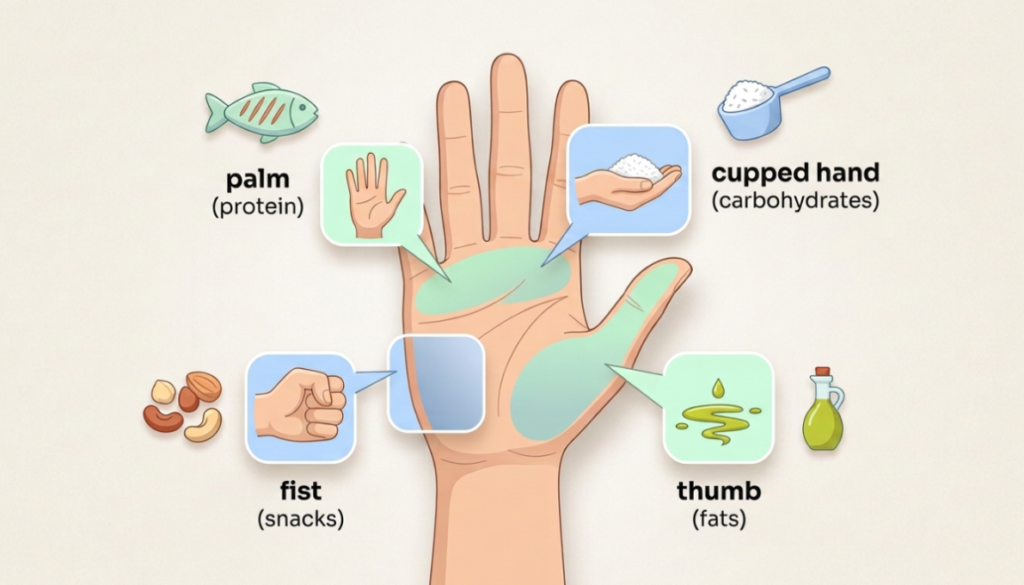
The most practical portion control method uses your own hand as a built-in measuring tool. It travels with you, scales naturally to your body size, and requires no equipment.
| Food Category | Hand Guide | Approximate Amount |
|---|---|---|
| Protein (meat, fish, tofu) | Palm size, thickness of your palm | 3–4 oz (85–115 g) |
| Carbohydrates (rice, pasta, grains) | Cupped hand | ½–1 cup |
| Vegetables | Both hands cupped together | 1–2 cups |
| Fats (oils, nut butter, cheese) | Thumb size | 1–2 tablespoons |
| Snacks (nuts, chips, dried fruit) | Single fist | About 1 cup |
This method isn’t precise to the gram, but it doesn’t need to be. The goal of portion control is consistency, not perfection. Someone who eyeballs portions correctly 80% of the time will see better long-term results than someone who measures perfectly for a week and then abandons the habit entirely.
Read also: “Strength Training Benefits: 12 Science-Backed Reasons“
A Step-by-Step Method for Everyday Meals
Building portion awareness works best as a repeatable routine rather than a one-time decision.
- Use a smaller plate for main meals. A 9-inch plate naturally limits volume compared to a 12-inch plate, without requiring any conscious restriction.
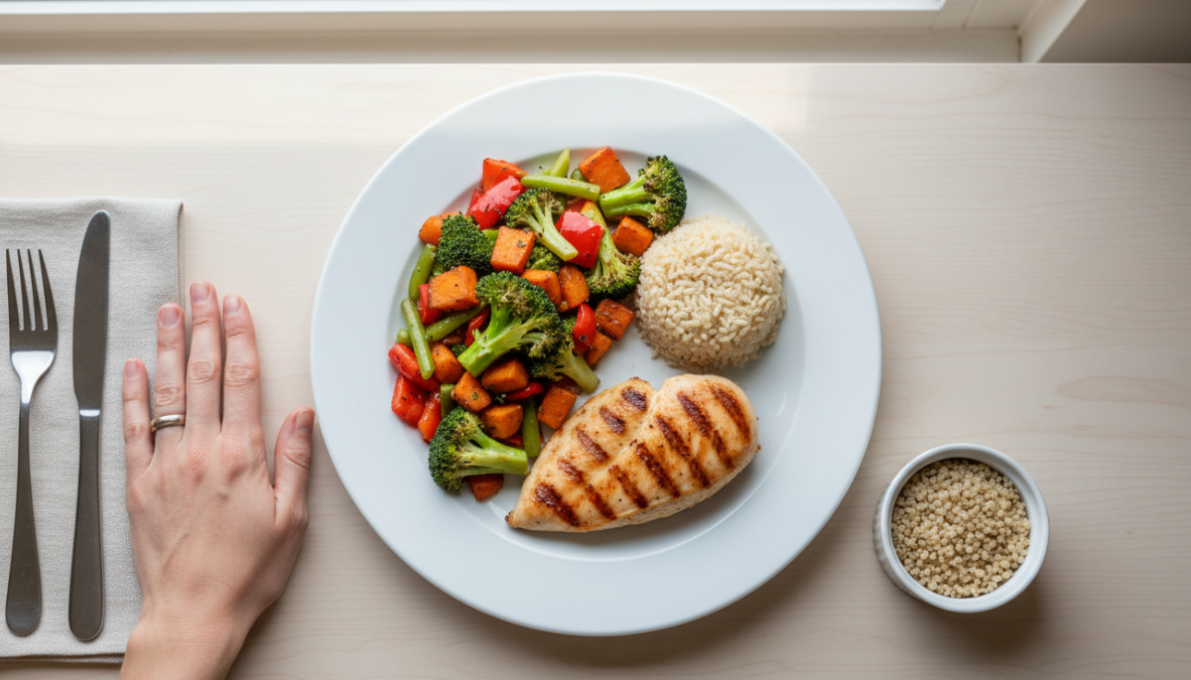
- Fill half the plate with vegetables first. This anchors the meal’s visual base before higher-calorie foods are added.
- Add a palm-sized portion of protein. Place it before the carbohydrate portion, since protein tends to increase fullness more per calorie.
- Add one cupped-hand portion of carbohydrates. This keeps grains and starches proportionate rather than dominant.
- Pause before serving seconds. Waiting 10–15 minutes allows fullness signals from the stomach to reach the brain, which typically takes about 20 minutes.
- Pre-portion snacks into small containers. Eating directly from a large bag removes the natural stopping point a portioned amount provides.
Following this sequence consistently, even loosely, tends to matter more than any single meal being “perfect.”
Common Portion Control Mistakes
A few recurring habits quietly undermine portion awareness, even for people who are otherwise mindful about food choices.
- Eating while distracted by a screen, which disconnects attention from fullness cues and often leads to eating past comfortable satiety.
- Treating “low-fat” or “sugar-free” labels as a green light for unlimited quantity, when these products can still be calorie-dense.
- Skipping meals earlier in the day, which frequently leads to oversized portions later due to intense hunger.
- Drinking calories — sodas, juices, and specialty coffee drinks — without mentally accounting for them as part of total intake.
- Serving food directly from large family-style dishes at the table, which makes second and third helpings effortless and less noticeable.
Recognizing these patterns is often more useful than any single portioning trick, because awareness of why overeating happens tends to prevent it more reliably than willpower alone.
Portion Control Across Different Meals and Situations
Breakfast
Morning meals benefit from a protein-forward approach — eggs, Greek yogurt, or cottage cheese paired with a modest carbohydrate portion. This combination tends to reduce mid-morning cravings compared to carbohydrate-heavy breakfasts alone.
Lunch and Dinner
The plate method described above (half vegetables, one palm of protein, one cupped hand of carbohydrates) applies most directly to these two meals, since they typically involve the widest variety of food groups.
Snacks
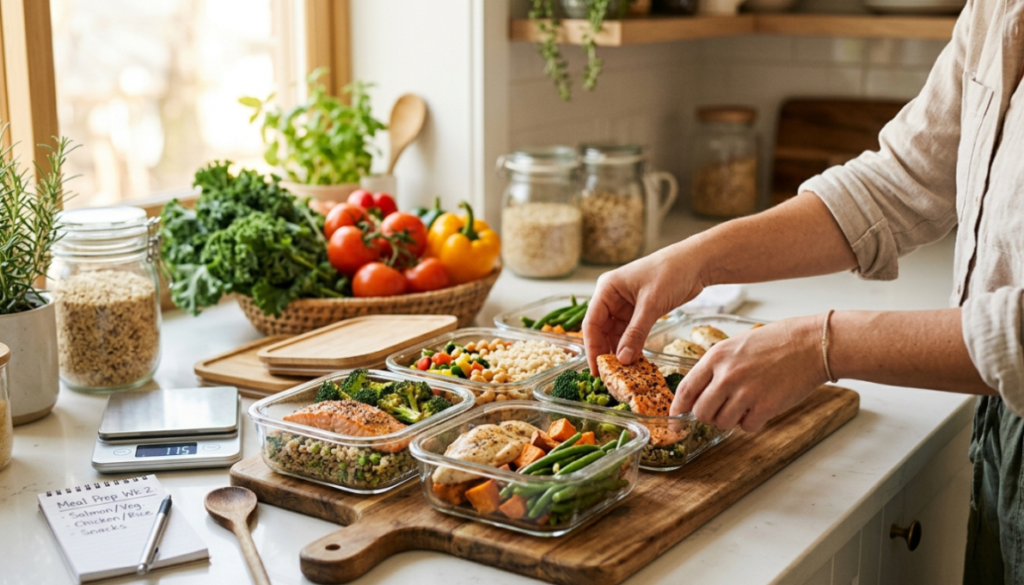
Snacks are where portion distortion happens most easily, because they’re often eaten straight from packaging. Pre-portioning nuts, crackers, or fruit into small containers ahead of time removes the guesswork entirely.
Eating Out
Restaurant portions frequently represent two or more standard servings in a single dish. Asking for a to-go box at the start of the meal, or splitting an entrée, are practical ways to align restaurant servings with actual portion needs.
Read also: “Caffeine Effects on Health: Benefits, Risks & Limits“
Tools That Make Portion Control Easier
Some people benefit from lightweight visual tools during the early stages of building this habit: divided portion-control plates with built-in sections, small food scales for a few weeks to calibrate the eye, or measuring cups kept visibly in the kitchen rather than tucked away in a drawer. None of these are required long-term — they function as training wheels while the hand-based method becomes second nature.
Building the Habit for the Long Term
Portion control tends to stick when it’s treated as a skill rather than a rule. Skills improve with repetition and get easier over time; rules feel restrictive and eventually get broken. Starting with just one meal a day — often dinner, since it’s usually the largest — and applying the plate method consistently for two to three weeks is typically enough for the visual habit to become automatic.
A practical portion control guide doesn’t require calorie apps, food scales, or rigid meal plans to be effective. It relies on visual anchors like the hand method, awareness of common distortion triggers, and small structural changes — smaller plates, pre-portioned snacks, a pause before seconds. These habits compound over weeks and months, making portion control less about restriction and more about eating in a way that genuinely matches what your body needs. Start with one meal today, and let the rest follow naturally.
Important disclaimers
The information in this article is for educational and informational purposes only and does not replace guidance from a qualified healthcare professional. Individual nutritional needs vary based on age, health conditions, activity level, and other factors. Consult a doctor or registered dietitian before making significant changes to your diet, especially if you have a medical condition.
Frequently Asked Questions
What is the easiest way to control portions without counting calories?
Using your hand as a measuring guide — a palm for protein, a cupped hand for carbs, both hands for vegetables — is the simplest calorie-free method for estimating appropriate portion sizes.
Does using a smaller plate really reduce how much I eat?
Yes, smaller plates make portions look larger relative to the plate’s surface, which tends to reduce how much food people serve themselves without consciously trying to eat less.
How long does it take to build a portion control habit?
Most people notice the hand-based method becoming automatic after two to three weeks of consistent practice at one or two meals per day.
Is portion control the same as dieting?
No. Dieting typically involves restricting specific foods or calorie totals, while portion control simply adjusts the amount of food eaten without eliminating any food group.
Why do restaurant portions feel normal even though they’re large?
Repeated exposure to oversized restaurant servings recalibrates what the brain perceives as a “normal” amount, making standard home portions feel smaller by comparison.
Can portion control help with weight management?
Reducing portion sizes lowers total calorie intake without requiring food restriction, which is one reason portion awareness is commonly used as part of weight management strategies.
Should I measure every meal with a food scale?
Not necessarily. A scale can be useful for a few weeks to calibrate visual judgment, but most people transition to hand-based or plate-based methods for daily use.

My relationship with health and wellness began on a personal level, looking for practical ways to improve my own routine: more movement, more mindful eating, and basic oral care habits that, over time, made a real difference in my quality of life. It was this ongoing process of learning — testing, researching, and adjusting — that motivated me to share what I learn with others on the same journey.